Two brands, one storefront, one shared language.
Experience strategy for the global commerce replatform that brought Shark and Ninja together at SharkNinja.com, where every decision had to speak data.
Huge Inc. · 2025SharkNinja, the global consumer products company behind Shark and Ninja.
Experience strategy for the direct-to-consumer replatform unifying Sharkclean.com, Ninjakitchen.com, and Ninjatestkitchen.com into SharkNinja.com. Huge Inc., January–August 2025.
Product Strategist leading data strategy, in a deliberately overlapping pair with business strategy.
Salesforce Commerce Cloud (SFRA), built by Salesforce.
Two of the most loved brands in consumer products were becoming one storefront, and almost nothing about how was settled.
The work started before the scope was fully signed. The brands were merging with no unified brand, content, or product strategy behind them. And the platform build had already begun, with Salesforce developing against out-of-the-box capabilities before the experience team arrived, which meant the default trajectory was a storefront shaped by what the platform ships with rather than what users need.
Layered over all of it was the thing that made this engagement distinctive: a client culture that is genuinely, relentlessly data-driven. Every strategic and creative decision had to be justified with evidence, for an audience strategy reaching toward Gen Z shoppers who buy differently than the brands' traditional base. That culture is a gift when the data exists. But the program had high-level objectives and no defined OKRs, no KPI plan, and no measurement framework.
Fragmented stakeholders, a vendor with scope momentum, two brands becoming one, and no shared basis for deciding anything. That was the starting position.
A data-demanding organization had no agreed way to evaluate the decisions it was demanding data for.
When the build has already started and every stakeholder wants something different, what makes decisions possible at all? Not authority, and not opinion. A shared language that every decision has to speak.
The conversion equation as the program's operating system
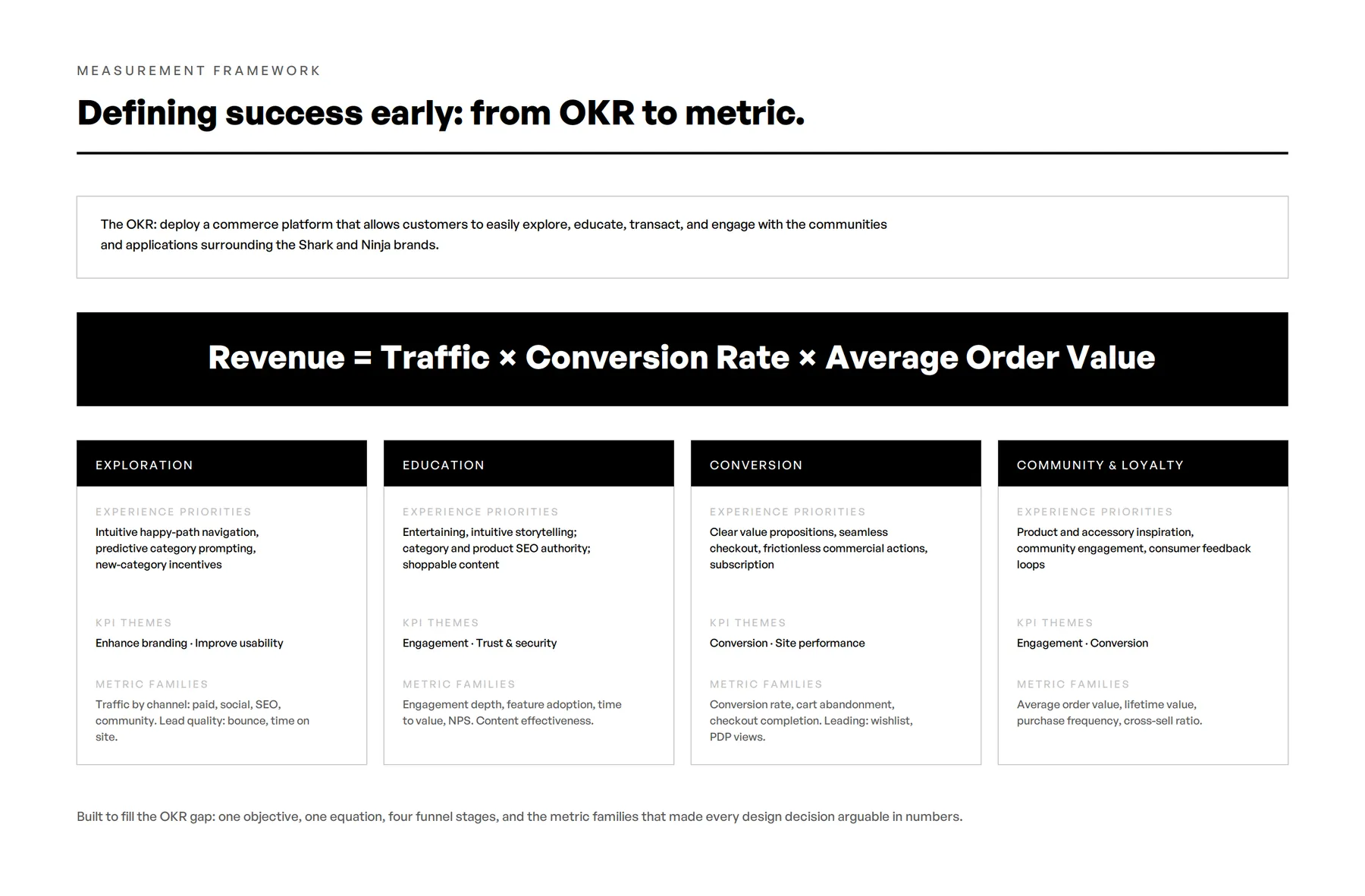
I built the measurement framework that filled the strategic gap, organized around a formula simple enough for every stakeholder to hold: Revenue = Traffic × Conversion Rate × Average Order Value. Beneath it, four funnel stages with their metric families: Exploration, Education, Conversion, and Community & Loyalty. Once installed, the framework did more than measure. It became the language in which priorities were argued, and a data-demanding client could say yes quickly because every recommendation arrived already speaking it.
Journeys rebuilt from wishlist to reality
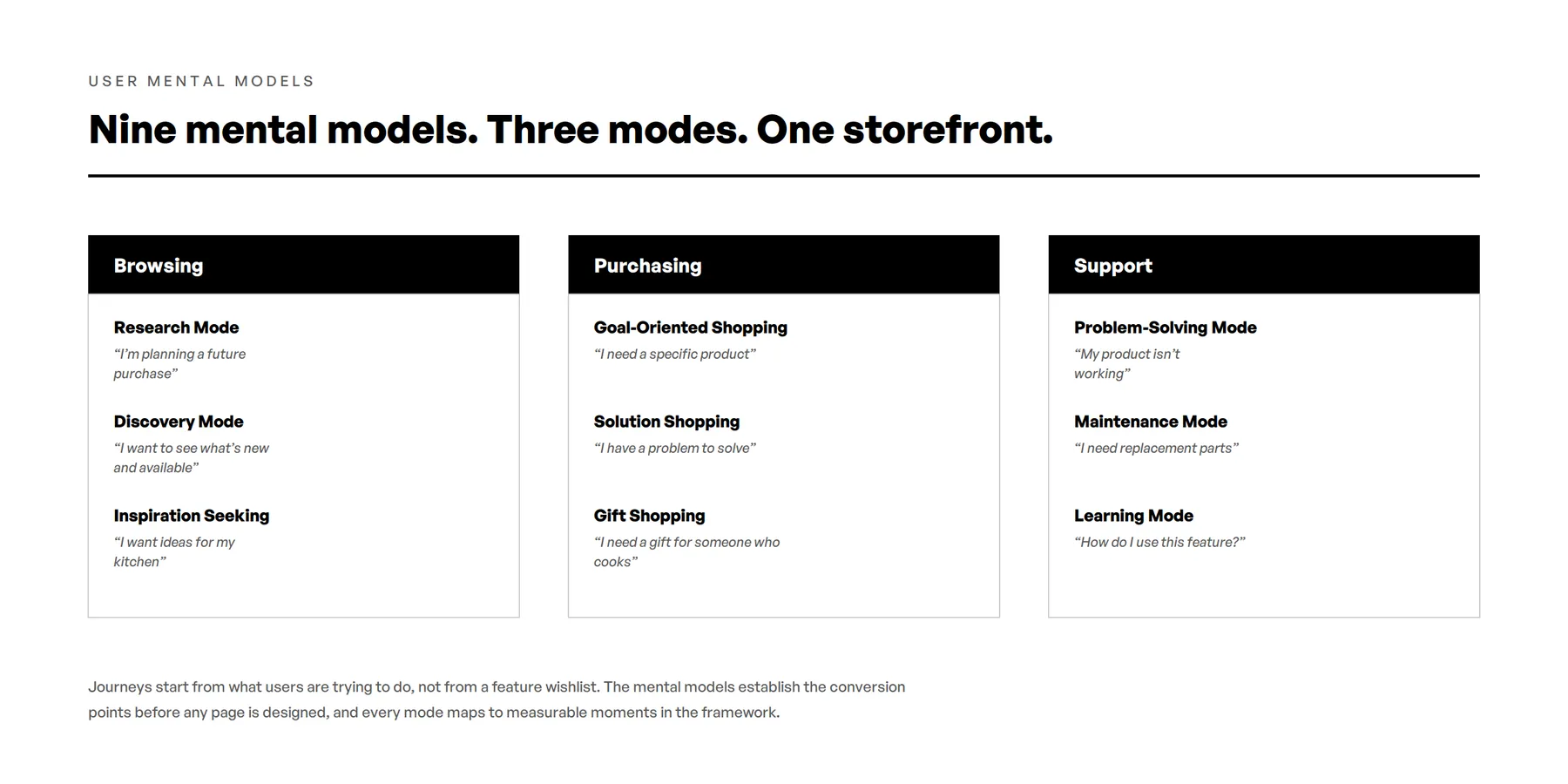
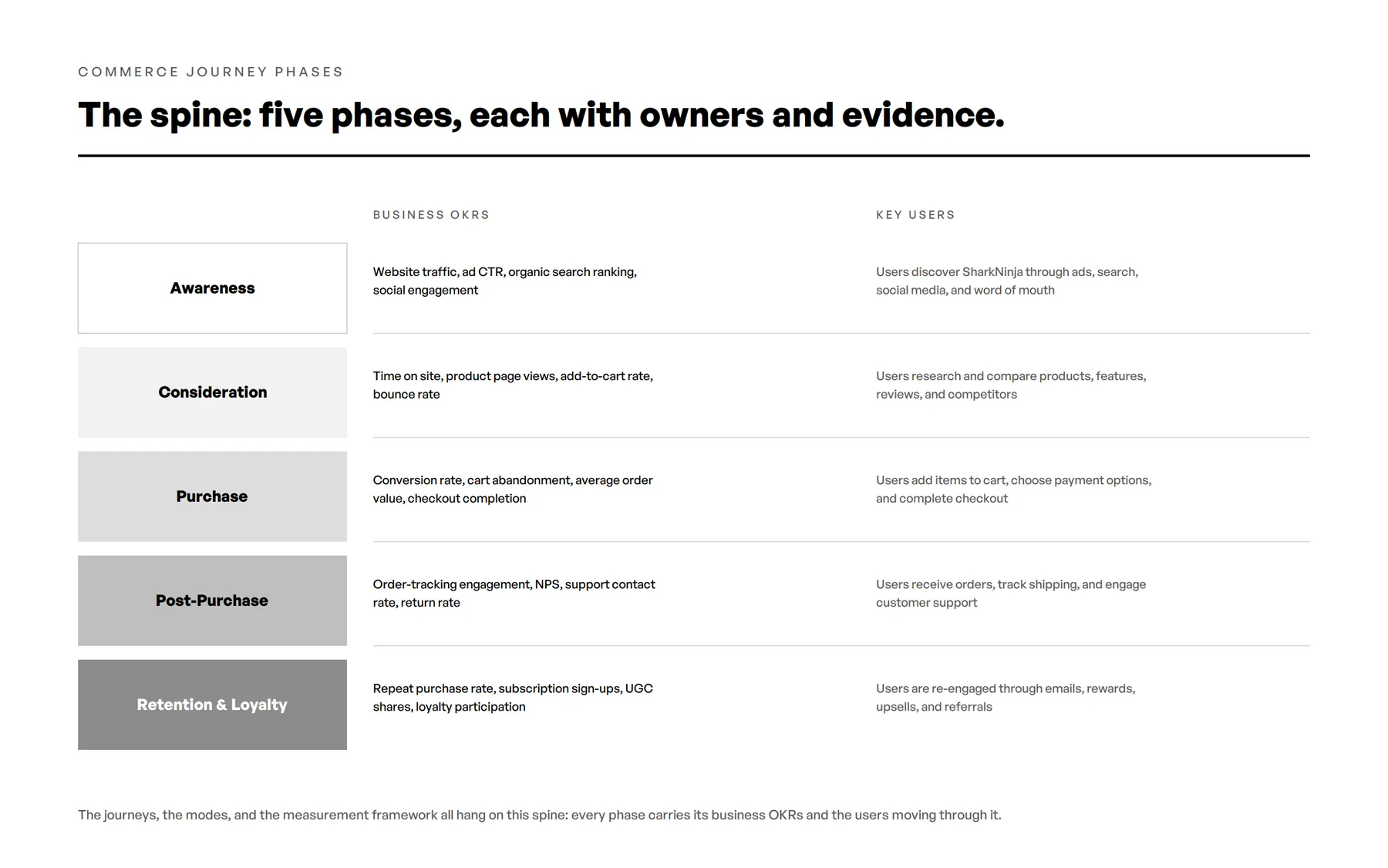
The scope listed fourteen journey types, a wishlist. I reframed the work around the paths users actually take, defining journey maps across three modes, Browsing, Purchasing, and Support, mapped over the full funnel from awareness through retention, tied to the OKR framework and to the personas that mattered commercially, including the subscription shopper whose lifetime value made her the quiet hero of the strategy. The modes gave design and content a user reality to build for instead of a feature list to satisfy.
The blueprint that protected the experience
With the platform build already moving, opinion was not going to redirect it. I created the functional requirements blueprint, a detailed table specifying, for every feature and component, what was out-of-the-box versus custom, what was new versus reused, and where the dependencies and handoffs sat. It gave Salesforce clarity to build against, and it gave the experience team protection: custom investment was argued from journey evidence and conversion impact, not preference, which is the only argument a platform vendor and a data-driven client will both accept.
A roadmap that balanced ambition with the clock
I built the phased roadmap with the delivery team, sequencing the build under a tight timeline using the same evidence logic: out-of-the-box first where the equation said the difference was marginal, custom where the journeys said the experience would win or lose.
Pages the client could own
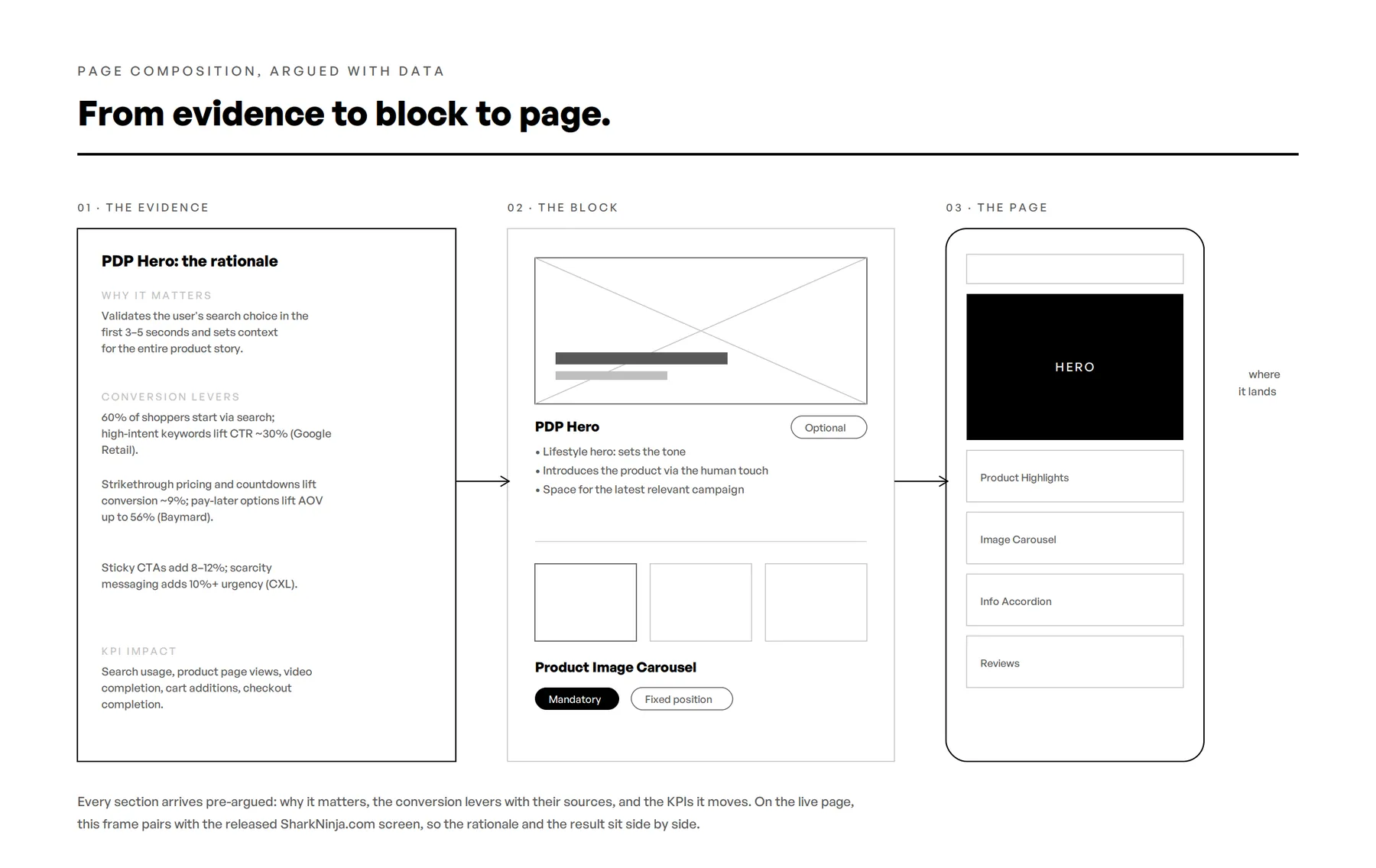
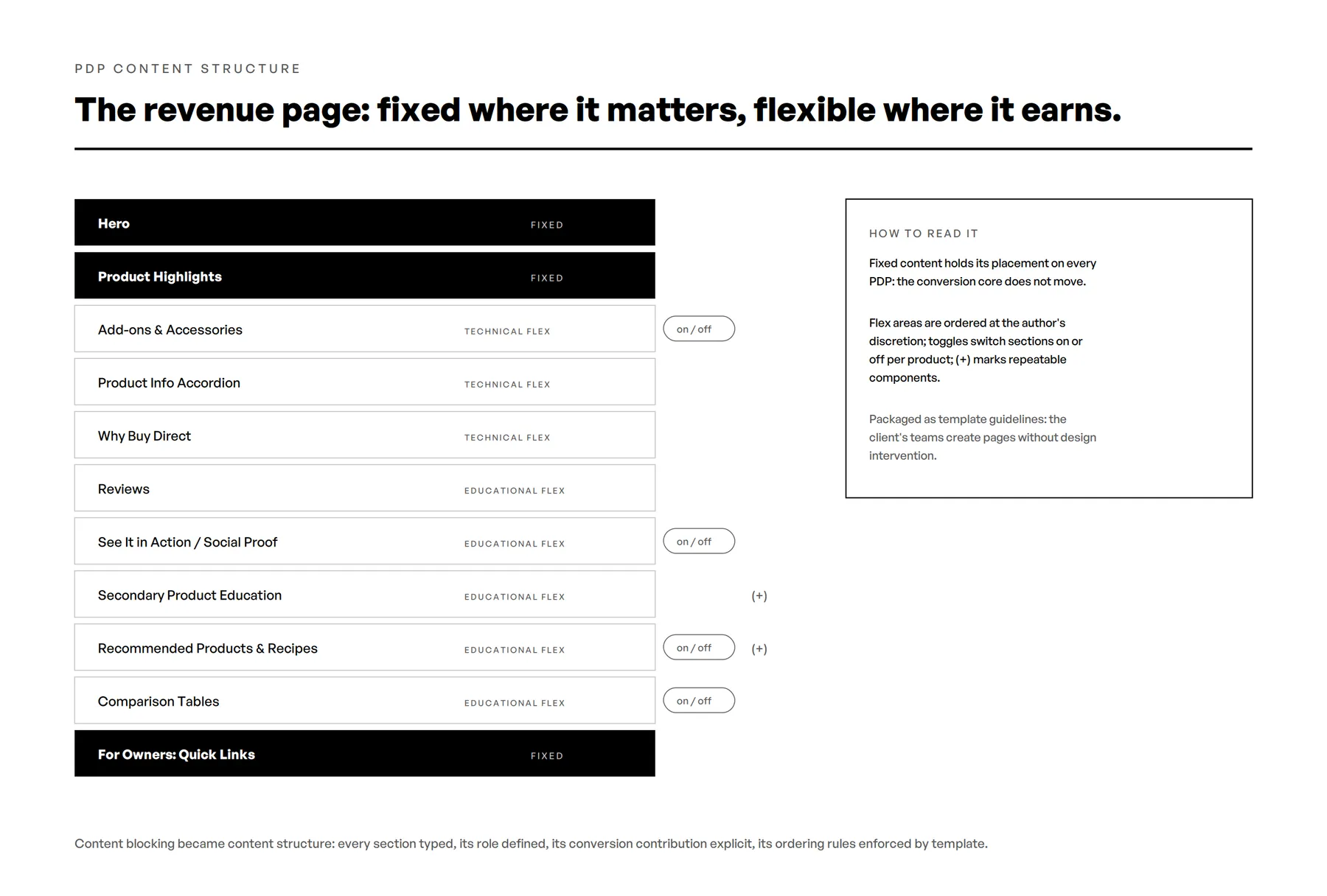
For the product detail page, the storefront's revenue engine, I helped define the content structure framework: every section of the page typed and assigned a role, with its expected conversion contribution made explicit, packaged as template guidelines the client's own teams could use to create pages without design intervention. The same thinking extended into the landing page guidebook and the support and subscription journeys.
A cross-discipline model that outlived the project
The strategy was produced in a deliberately overlapping pair: I leaned into data strategy, my business strategy partner leaned into content, and we reviewed and strengthened each other's work continuously. The collaboration worked well enough that we documented it for the agency as a model for how product and business strategy should operate together.
Refusing to fight the platform with opinions
The program's central tension was a vendor building OOTB-first against an experience vision that needed more. The losing move was a turf war. Instead, every custom-versus-stock decision was routed through the equation and the journeys: where the evidence said out-of-the-box was good enough, we conceded fast, and where it said the experience would win or lose, the case for custom arrived with numbers attached. The program moved from platform-first to experience-led without a single argument that was really about territory.
Cutting the wishlist
Fourteen journey types was a scope, not a strategy. Anchoring the work to the three modes users are actually in meant telling stakeholders their journey was a variant, not a headline. The measurement framework made that survivable: priorities argued in conversion language stop being personal.
SharkNinja.com launched publicly in October 2025 as the unified direct-to-consumer destination for both brands: mobile-first, social-first, with commerce, content, community, and post-purchase support in one place.
The program that shipped it had been transformed on the way: from fragmented stakeholders to an aligned roadmap, from no defined requirements to structured intake and decision-making clarity, from a vendor dictating scope to experience-led priorities, and from no measurement plan to a conversion framework the shared client dashboard was still tracking against months after strategy handoff.
"Data-driven" fails in most organizations for a reason nobody likes to name: everyone brings data as a weapon, and decisions still come down to who argues loudest. It works when there is one framework every decision has to speak, installed early, simple enough to be shared, and connected to the money. On this program, the conversion equation was that framework. It aligned an agency, a platform vendor, and a data-obsessed client without requiring any of them to lose, and it turned a replatform that had started platform-first into the experience-led storefront that shipped.